Commercial · Roof
Rooftop Units
Packaged rooftop units on commercial buildings across Houston: Trane installs, emergency repair when a unit drops out, and semi-annual preventative maintenance.
What goes wrong on a roof nobody visits
A packaged rooftop unit holds the whole system in one cabinet: compressor, condenser coil, evaporator coil, blower and either gas or electric heat, all sitting on a curb above the ceiling it serves. That is efficient for a commercial building, and it also means the equipment lives where nobody sees it until the rooms below start getting warm.
The usual faults are mechanical and electrical, and the roof makes each one a little harder to spot. Blower belts stretch and slip. Economizer dampers stick open or shut. Coils collect dirt and cottonwood and stop shedding heat. A condensate pan overflows and the water sits on the membrane. Contactors and capacitors weaken in the sun. A curb seal that has opened up lets rain into the building around the unit.
From inside, the signs are blunt: a space that will not hold temperature, a unit that cycles on and off every few minutes, a stained ceiling tile under the roof equipment, or a bill that climbs while comfort falls. Each one is worth a visit before the first 95 degree afternoon turns it into an emergency. Water at the ceiling in particular should never be put off, because it means moisture is already moving where the building does not want it.
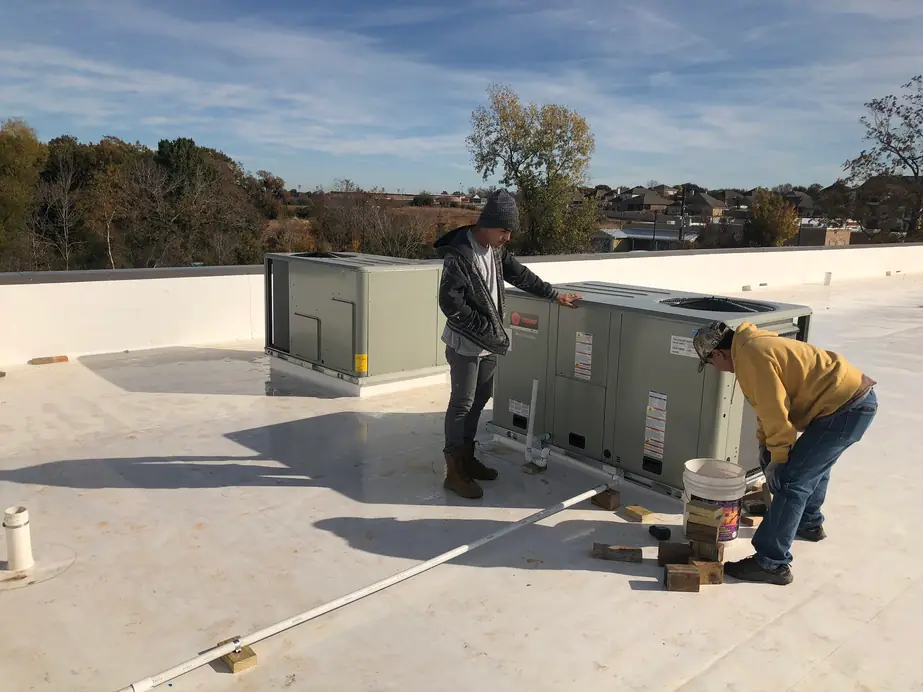
Two Douglas crew setting Trane rooftop units on a white membrane roof
Trane units set, repaired and kept running
Douglas Mechanical installs Trane rooftop units, and the photo on this page shows its own crew setting them on a white membrane roof. The company is a Trane Comfort Specialist, which Trane describes as a designation awarded to the most qualified specialists, and it uses factory authorized brand name equipment and parts.
A replacement is more than lifting a box. The new cabinet has to match the curb, or be carried on an adapter when its footprint differs, and the lift is planned around the weight of the unit and the route to the roof. After the unit is set come the power and control connections, the condensate run and the start-up checks, all of which are the same craft whether the unit is the first on a building or the fourth.
When a unit drops out, Douglas Mechanical covers emergency commercial repair, and it states that certified technicians are available around the clock to limit downtime. On ordinary days the trucks are out from 8am-8pm, seven days a week. Its technicians are trained to diagnose first and recommend only the work you actually need, and the company does not employ salesmen or work on commission.
Between breakdowns: the semi-annual visit
Rooftop units are covered by the same semi-annual commercial maintenance programme as the rest of a building's HVAC: routine inspections, deep cleanings and tuneups twice a year. For a roof unit that usually means coils washed, belts and bearings checked, the condensate pan and drain cleared, the economizer worked through its travel, and the electrical connections looked over.
Doing it before the cooling season and again before winter fits how Houston buildings run. The visit before summer finds the weak belt or the failing capacitor while it is still a small repair. The visit before winter checks the heat section, so the first cold morning is not also the first time the burners have fired in months.
It also keeps the roof itself healthier. A drain that runs freely does not pool water on the membrane, and a unit that is level and sealed at the curb does not invite leaks. Roof access is also part of the plan, since a unit that is easy to reach gets inspected properly instead of glanced at from the ladder. For the wider picture of how Douglas Mechanical approaches commercial buildings, the commercial HVAC page covers installation, emergency repair and maintenance as one program.
Trane Comfort Specialist, Texas HVAC License TACLA20014C, in business in Spring since 1975. Technicians are in the field 8am-8pm, seven days. The office is at (281) 299-0949.